
Cross-Organization Vendor Operations in One Command Center
See pickup requests, route and fleet coordination, acknowledgement queue, proof and invoicing, SLA benchmarks, and material mix across every dealer group the vendor serves — in one operating record.
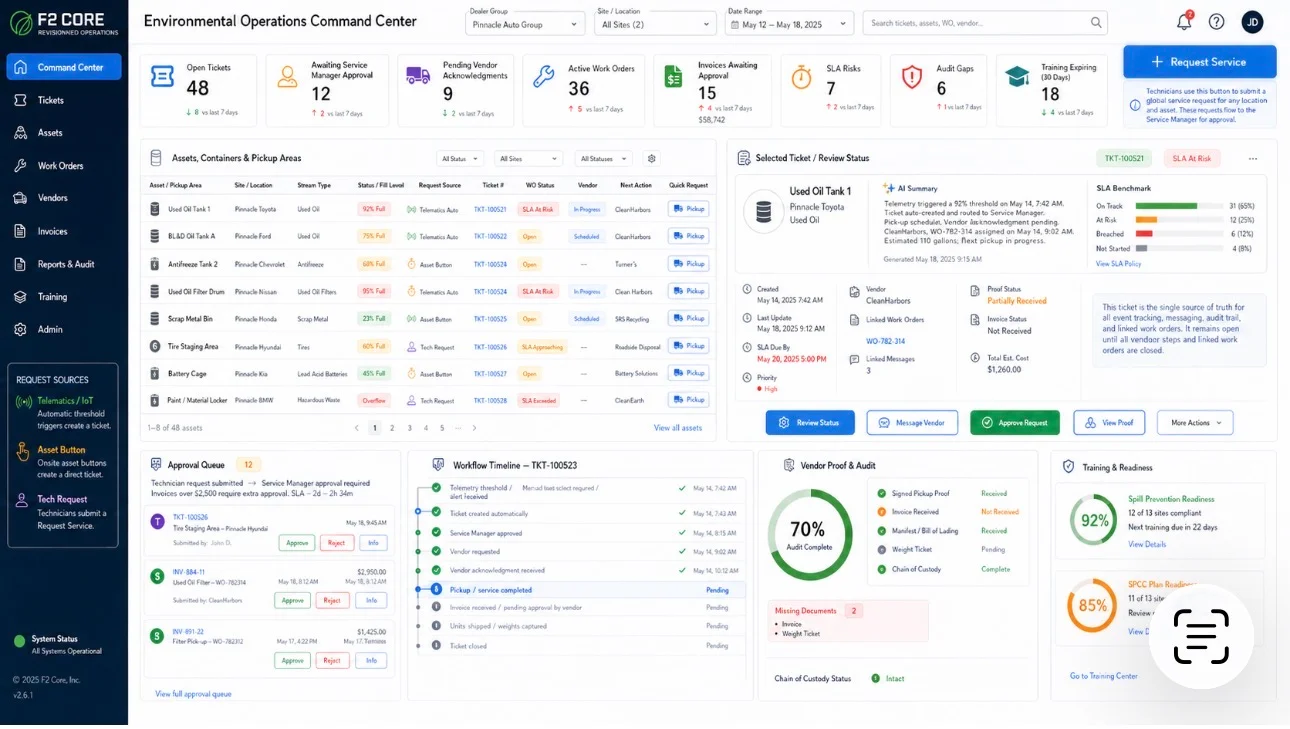
Multi-organization scope
Pickup, route, and fleet visibility
Acknowledgement, proof, and invoicing queues
SLA benchmark and material mix
The vendor KPI strip
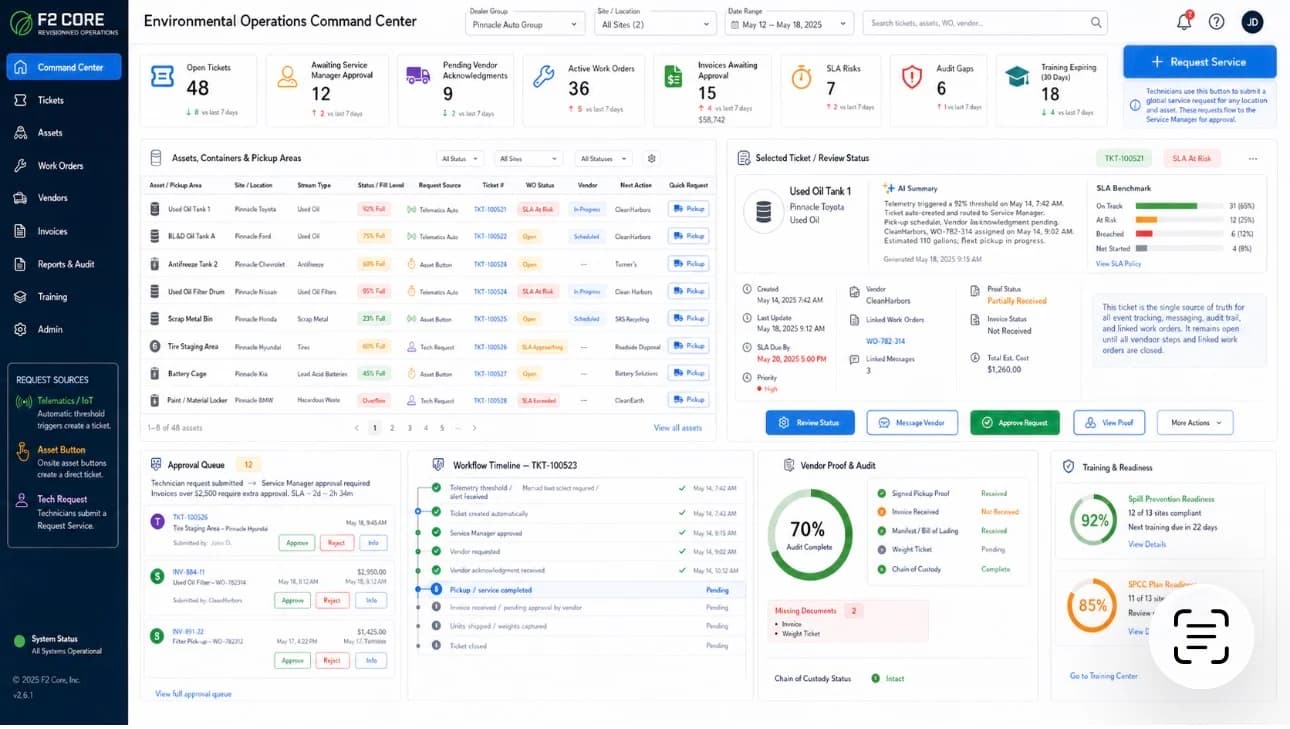
Eight KPI cards summarize the operating load across every dealer group in scope. Counts and dollar exposure are tied to the underlying records — no hard-coded metrics.
Open pickup requests
Live count of pickup requests by dealer group, region, and material — across every organization in the vendor scope.
Awaiting acknowledgement
Requests sent to vendor but not yet acknowledged. SLA timer is visible per request.
Scheduled stops today
Stops planned for the day with vendor team, truck assignment, and expected completion window.
Trucks in service
Active fleet count plus utilization rate. Fleet count includes vendor-provided data; advanced fleet management is Phase 2.
Capacity risks
Stops where estimated volume or weight exceeds available truck capacity in the configured route.
SLA risks
Requests at risk of breaching acknowledgement, schedule, completion, or proof SLAs.
Proof pending
Stops where signed pickup proof, manifest, BOL, or weigh ticket has not arrived. Dollar exposure shown.
Invoices pending
Submitted invoices awaiting review and approval, with dollar exposure shown.
Proof & invoicing queue
Every stop has a required-proof matrix. Missing proof blocks AP closeout. Vendor invoices match against the proof package before approval and AP handoff.
Signed pickup proof
Per-stop signed proof with vendor, site, material, and timestamp.
Manifest / BOL
Manifest and bill of lading retained in the document library with the pickup record.
Weigh ticket
Weigh ticket with scale, material, and weight tied to the stop and the invoice.
Invoice submitted
Invoice or credit memo submitted by the vendor, tied to the proof package and AP gate.
Route, fleet, and material mix
Route planning, truck capacity, fleet overview, and material mix support dispatch decisions. Manual dispatch is MVP scope; advanced route optimization, fleet capacity automation, and SLA benchmark scoring are Phase 2 unless implementation is confirmed.
Route planning
Group stops by material compatibility, region, SLA, and truck type. Manual dispatch is MVP; advanced route optimization is Phase 2.
Truck capacity
Capacity check compares estimated volume, weight, or count against truck capacity — flags overruns before dispatch.
Fleet overview
Visibility into each truck's current fill, next stop, ETA, and assigned vendor team.
Material mix
Material distribution by volume or weight across the day's scheduled stops.
What's MVP, what's Phase 2
The Vendor Operations Command Center supports cross-organization visibility of pickup requests, acknowledgements, proof, invoicing, and SLA tracking. The view is scoped by vendor and tenant permissions — vendors only see what they are authorized to see.
Advanced route optimization, automated truck capacity assignment, real-time SLA benchmarking, predictive capacity planning, and fleet telematics integration are Phase 2 unless the dealership and vendor confirm implementation scope.
MVP: pickup queue, acknowledgement queue, proof and invoicing, manual dispatch, SLA tracking.
MVP: per-vendor and per-tenant scoping enforced at API layer.
Phase 2: route optimization, truck capacity automation, predictive analytics.
Phase 2: AI summaries, automated invoice OCR.
Vendor cannot close dealership tickets — only the dealership team can.
Environmental compliance disclaimer
F2 Core supports environmental workflows, organization, documentation, and evidence readiness. It is not a substitute for legal advice or a qualified environmental compliance review.
See vendor operations on real multi-org data
Walk through the Vendor Operations Command Center, pickup queue, acknowledgement workflow, proof and invoicing, and dispatch coordination on real-world dealership and vendor data.